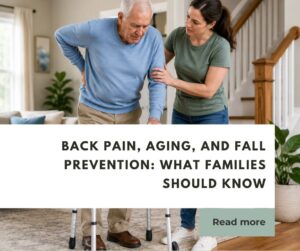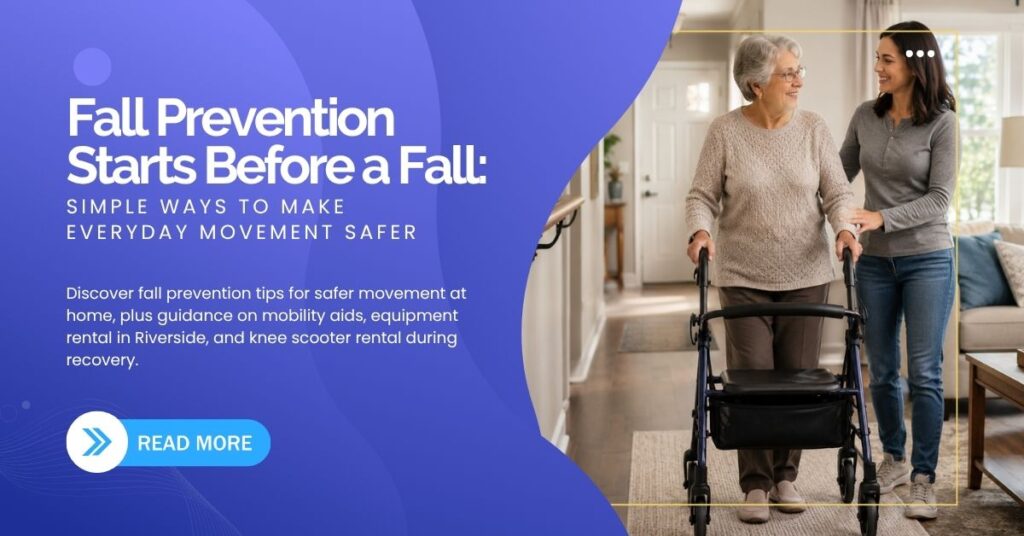
A fall can happen in seconds, but many of the conditions that contribute to a fall develop gradually.
A hallway becomes harder to navigate. Getting up from a favorite chair takes more effort. Balance isn’t quite what it used to be. A loose rug stays in the same place because no one has tripped over it—yet.
For older adults and their families, fall prevention shouldn’t begin after an accident. It should begin while someone is still active, independent, and able to make small changes that can help everyday movement feel safer.
Fall prevention is also important during temporary periods of limited mobility. Someone recovering from surgery or a foot, ankle, or lower-leg injury may suddenly have difficulty moving safely around the home even though they normally walk without assistance. In these situations, having appropriate temporary mobility equipment can be an important part of preparing the home.
Families may consider equipment rental in Riverside when a wheelchair, mobility scooter, hospital bed, or other recovery product is only needed temporarily. For certain injuries or procedures, a knee scooter rental may also provide a short-term mobility option when appropriate for the person’s recovery instructions.
September’s focus on fall prevention is a useful reminder to look at the places, routines, and mobility challenges that are easy to overlook.
The good news is that improving safety doesn’t necessarily require major changes. Often, a series of small adjustments can make everyday life easier while helping people continue doing more for themselves.
Start by Looking at How Someone Moves Through the Home
When you’ve lived in the same home for years, it’s easy to stop noticing potential obstacles.
Try walking through the home specifically looking for anything that could interfere with safe movement.
Pay attention to:
- Loose or curling rugs
- Electrical cords crossing walkways
- Clutter around furniture
- Dim hallways
- Uneven flooring
- Small tables or decorative items in walking paths
- Frequently used objects that require reaching or bending
- Pets or pet supplies in high-traffic areas
The goal isn’t to completely redesign the home. It’s to make the routes someone uses every day as simple and predictable as possible.
The path between the bedroom and bathroom deserves particular attention because it may be traveled at night when someone is tired and lighting is limited.
Families should also think about whether a walker, wheelchair, knee scooter, or other mobility device can move comfortably through those same pathways. A walkway that feels spacious to someone walking independently can suddenly feel very narrow when mobility equipment is introduced.
Don’t Wait for Balance Problems to Become Severe
Changes in balance and strength aren’t always dramatic.
Someone may begin reaching for furniture while walking through a room. They may avoid stairs they once used regularly. They might hesitate before stepping off a curb or begin limiting outings because they’re worried about becoming tired.
These can be useful signals that it’s time to discuss mobility and safety.
A healthcare professional can help evaluate changes in strength, balance, medications, vision, or other factors that may contribute to fall risk.
When appropriate, mobility aids such as walkers and rollators can provide additional support.
Someone recovering from a foot, ankle, or lower-leg injury may have completely different mobility needs. If a healthcare professional has instructed the person to avoid putting weight on the affected area, a knee scooter rental may be one temporary option worth discussing.
Using mobility equipment doesn’t necessarily mean someone has lost independence. In many situations, appropriate support can help a person continue being independent more safely.
Make the Bathroom a Priority
If you’re only going to evaluate one room for potential safety improvements, start with the bathroom.
Bathrooms combine several challenges: water, slippery surfaces, hard flooring, limited space, and movements that require sitting, standing, turning, and stepping.
Consider whether someone can comfortably:
- Get into and out of the shower
- Stand while bathing
- Sit down and stand up from the toilet
- Reach towels and toiletries
- Move through the room without grabbing unstable objects for support
Depending on individual needs, bathroom safety products might include grab bars, shower chairs, transfer benches, raised toilet seats, nonslip surfaces, or other appropriately selected aids.
Don’t assume someone needs to experience a fall before these products become useful. Preventive changes are often much easier to make than changes made during recovery from an injury.
Improve Lighting in the Places That Matter Most
Good lighting is one of the simplest home-safety improvements.
Make sure stairways, hallways, entrances, bathrooms, and bedrooms are adequately illuminated.
Nightlights can be particularly useful along routes someone may use after dark.
Also consider the placement of light switches. If someone has to cross a dark room to reach a switch, a different lighting solution may make more sense.
Outdoor lighting matters too. Steps, uneven pavement, driveways, and walkways can become significantly more difficult to navigate when visibility is poor.
Choose Shoes With Safety in Mind
Footwear is easy to overlook when thinking about fall prevention.
Shoes that don’t fit properly, have worn soles, or provide inadequate traction can make walking more difficult.
At home, be cautious with loose slippers or socks on smooth flooring.
Comfort is important, but so are stability and traction.
Someone who has recently changed their walking pattern or begun using a mobility aid may also want to discuss appropriate footwear with their healthcare provider.
Temporary Mobility Challenges May Need Temporary Solutions
Fall prevention isn’t only an issue for older adults with long-term mobility changes.
Surgery, illness, or an injury can temporarily change the way someone moves.
A person who normally walks confidently may suddenly be unable to put weight on one leg. Someone returning home from the hospital may have less strength and stamina than they did before. Another person may need a wheelchair for several weeks while recovering.
That doesn’t necessarily mean the family needs to purchase every piece of equipment.
For people looking for equipment rental Riverside options, renting can provide access to temporary mobility and recovery equipment without immediately making a long-term purchase.
Depending on availability and individual needs, rental equipment may include:
- Wheelchairs
- Mobility scooters
- Knee scooters
- Hospital beds
- Patient lifts
- Oxygen concentrators
- Other mobility and recovery equipment
A knee scooter rental, for example, may be useful for certain foot, ankle, or lower-leg recoveries when the individual has received appropriate instructions regarding mobility and weight bearing.
The key is to plan before the equipment is urgently needed.
If a family knows someone will be returning home after surgery with limited mobility, arranging appropriate equipment beforehand can make the transition much easier.
Keep Moving—Safely
Fear of falling can sometimes cause people to become less active.
That can create another problem.
When someone significantly reduces movement, strength, flexibility, and balance may decline over time. Everyday activities can then become more difficult.
Appropriate physical activity can help older adults maintain strength and confidence. Walking, balance exercises, stretching, and strength activities may all be beneficial when appropriate for the individual’s abilities and medical circumstances.
The important word is appropriate.
Someone with existing balance problems, a recent injury, or a medical condition should discuss safe activity with their healthcare professional rather than starting an unfamiliar exercise program without guidance.
The objective isn’t intense exercise. It’s maintaining the ability to move safely and confidently through everyday life.
Make Frequently Used Items Easier to Reach
Think about how many times someone reaches above their head or bends toward the floor during an ordinary day.
Frequently used kitchen supplies, clothing, medications, toiletries, and household items should ideally be stored where they can be reached comfortably.
Using a chair as a makeshift step stool is an obvious risk, but people often do it because something they use regularly is stored too high.
A few minutes reorganizing cabinets, closets, and shelves can eliminate many unnecessary reaching and climbing situations.
Pay Attention to Getting Up and Sitting Down
Falls aren’t limited to walking.
Standing up from a bed, sofa, toilet, or chair can also become challenging when leg strength or balance changes.
Watch for signs such as:
- Repeated attempts to stand
- Pulling on nearby furniture
- Rocking forward for momentum
- Losing balance immediately after standing
- Dropping heavily into a chair when sitting
These difficulties shouldn’t simply be dismissed as part of getting older.
A healthcare professional may be able to identify contributing factors, while appropriate home equipment can sometimes make transfers easier.
For some individuals, products such as lift chairs or properly selected support equipment can make everyday routines more manageable.
Make Sure Mobility Equipment Still Fits the Person
Having a walker or rollator doesn’t automatically make movement safer.
The equipment needs to be appropriate for the person and used correctly.
Over time, needs can change. Equipment can also wear down.
Periodically look at:
- Handle height
- Wheels
- Brakes
- Grips
- Seats
- Frames
- General stability
If someone is leaning excessively, struggling with the equipment, or no longer feels confident using it, it may be time for a reassessment.
This is one advantage of working with a knowledgeable local medical equipment provider. Families can ask questions and compare options rather than assuming that whatever equipment is already in the house remains the best solution.
Think Beyond the Inside of the Home
Fall prevention shouldn’t stop at the front door.
Look at the routes someone regularly takes outside.
Are there cracks or uneven areas in the walkway? Are steps clearly visible? Is there a secure handrail? Does landscaping obstruct the path? Is the entrance adequately illuminated?
Also consider everyday destinations.
A person may be perfectly comfortable moving around their home but struggle with large stores, community events, parks, or long distances.
In those circumstances, an appropriate mobility aid may help conserve energy and provide additional support so the person doesn’t have to give up activities they enjoy.
For someone dealing with a temporary recovery, think about transportation as well. Will a wheelchair or knee scooter fit in the vehicle? Can the person safely get from the house to the car? What will they need when they arrive at a medical appointment?
Planning for these transitions is another important part of safer mobility.
Don’t Let Pride Prevent a Safety Conversation
Mobility can be an emotional subject.
An older parent may interpret a suggestion about a walker, rollator, or mobility scooter as someone telling them they’re becoming incapable.
That’s why the way families approach the conversation matters.
Instead of focusing on what someone can’t do, talk about what the right support might help them continue doing.
Rather than saying:
“You can’t walk safely anymore.”
Try:
“We want you to keep going shopping with us without worrying about getting tired.”
Or:
“Would having a little extra support make your walks more comfortable?”
Mobility equipment should be viewed as a tool for maintaining activity and independence—not automatically as evidence of losing them.
The same thinking applies to temporary recovery. Renting a wheelchair or choosing a knee scooter rental for a few weeks doesn’t mean someone has permanently lost mobility. It simply provides appropriate support while the body heals.
Local Support Can Help Families Make Better Decisions
It can be difficult to determine what type of mobility or home-safety equipment is appropriate by looking at pictures online.
Different walkers, rollators, wheelchairs, mobility scooters, bathroom safety products, and recovery equipment are designed for different needs. Being able to speak with knowledgeable local professionals can help families better understand their options.
For Riverside families dealing with surgery, an injury, or another temporary mobility challenge, equipment rental Riverside services can provide access to needed equipment without automatically requiring a permanent purchase.
Discount Medical – Mobility Equipment & Supplies has served Riverside-area families for years, providing mobility equipment, medical supplies, rentals, repairs, and personalized assistance. Customers can visit either of its Riverside locations:
Magnolia Avenue Location
10403 Magnolia Avenue, Suite A
Riverside, CA 92505
Downtown Riverside Location
3570 14th Street
Riverside, CA 92501
Families who only need equipment temporarily can also explore equipment rental in Riverside, including available mobility and recovery equipment for short-term needs.
Discount Medical – Mobility Equipment & Supplies is also expanding its local service into Orange County. Families in that area can visit the medical supply store in Costa Mesa for mobility equipment, medical supplies, rentals, and local assistance.
Whether someone needs a walker for greater everyday stability, a knee scooter rental during recovery, or another mobility solution, the goal should be to find equipment appropriate for the individual’s needs, abilities, home environment, and healthcare guidance.
Fall Prevention Is About Preserving Independence
Fall prevention shouldn’t make people afraid to move.
It should make movement safer and more confident.
Sometimes that means improving lighting.
Sometimes it means removing a loose rug, reorganizing a cabinet, adding bathroom safety equipment, checking a walker, or discussing balance changes with a healthcare professional.
And sometimes it means recognizing that a temporary mobility challenge requires additional support.
Families may need equipment rental in Riverside while someone recovers from surgery, a knee scooter rental may provide temporary mobility support during an appropriate foot or ankle recovery, or an Orange County family may need help finding the right equipment locally in Costa Mesa.
These tools aren’t the opposite of independence.
When properly selected and used, they can help people continue participating in everyday life while adapting to changing circumstances.
Most importantly, families don’t need to wait for a fall to start thinking about safety.
Take a look around the home. Pay attention to changes in movement. Ask questions. Address small problems before they become larger ones.
Because the best time to think about fall prevention is before a fall ever happens.
Frequently Asked Questions
What are some simple ways to reduce fall risks at home?
Removing tripping hazards, improving lighting, keeping walking paths clear, placing commonly used items within easy reach, evaluating bathroom safety, and making sure mobility equipment is appropriate for the user are practical places to start.
When should an older adult consider using a walker or rollator?
It may be worth discussing mobility support when someone experiences changes in balance, fatigue, walking confidence, or stability. A healthcare professional can help determine what type of support is appropriate.
Can staying active help with fall prevention?
Appropriate physical activity can help maintain strength, flexibility, and balance. The type and intensity of activity should match the person’s abilities and health circumstances.
Can families rent mobility equipment during a temporary recovery?
Yes. Renting can be practical when equipment is only needed for a limited period. Families researching equipment rental Riverside options may be able to rent wheelchairs, mobility scooters, knee scooters, hospital beds, patient lifts, and other equipment depending on availability.
When might someone consider a knee scooter rental?
A knee scooter rental may be an option during certain foot, ankle, or lower-leg recoveries when the individual’s healthcare professional has provided appropriate mobility and weight-bearing guidance. Whether a knee scooter is suitable also depends on factors such as balance, strength, and the home environment.
Does using mobility equipment mean someone is losing independence?
Not necessarily. Appropriate mobility equipment can help people conserve energy, improve stability, continue everyday activities, and remain more engaged while adapting to permanent or temporary mobility changes.
Where can families compare mobility and home-safety equipment?
A local medical supply store can help families compare available products, discuss how equipment will be used, and better understand the differences between mobility and home-safety solutions.